

Dimension 01
Structure
How authority and oversight are organized
Board architecture, delegation clarity, committee alignment, and the layers through which oversight is exercised.
Funston helps institutional boards make sense of complex governance information before emerging issues become significant problems. We bring together policies, risk indicators, audit findings, performance data, and peer context to show what has changed, why it matters, and where board attention is needed.
Market movements are easy to observe. Governance drift is not.
Policy discipline can weaken under pressure. Delegated authority can become less clear. Operating practices can gradually move away from their intended design. These changes may develop over time before they appear in traditional performance reporting.
Patient capital institutions therefore need more than periodic reviews. They need continuous governance intelligence that helps boards recognize structural changes, emerging risks, and decision implications earlier.
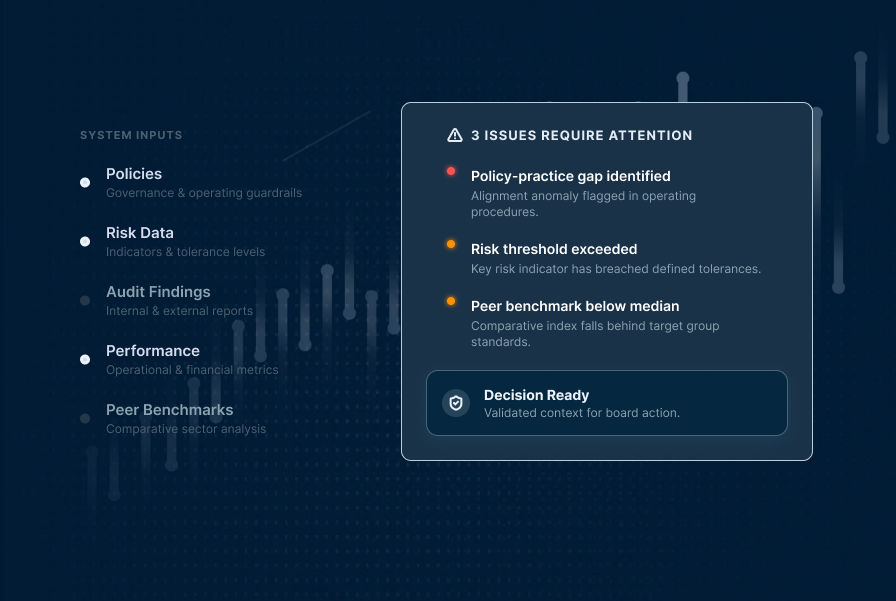
The purpose of intelligence is not to produce more information. It is to make the most consequential information easier to recognize and act on.
Market movements are easy to observe. Governance drift is not.
Policy discipline can weaken under pressure. Delegated authority can become less clear. Operating practices can gradually move away from their intended design. These changes may develop over time before they appear in traditional performance reporting.
Patient capital institutions therefore need more than periodic reviews. They need continuous governance intelligence that helps boards recognize structural changes, emerging risks, and decision implications earlier.
The purpose of intelligence is not to produce more information. It is to make the most consequential information easier to recognize and act on.
Funston benchmarks institutional investors across four connected dimensions. Together, they show how governance is designed, how it operates, and how it influences long-term outcomes.
Dimension 01
Structure
How authority and oversight are organized
Board architecture, delegation clarity, committee alignment, and the layers through which oversight is exercised.
Dimension 02
Policy
How institutional expectations are defined
Investment policy discipline, liquidity governance, delegation documentation, and fiduciary standards.
Dimension 03
Practice
How governance operates in reality
Operating model alignment, risk escalation pathways, decision cadence, and reinforcement through audit and assurance.
Dimension 04
Performance
How governance connects to outcomes
Risk-adjusted returns, information ratio, cost discipline indicators, and the relationship between governance and performance.
Each diagnostic translates governance architecture into measurable institutional insight.
Traditional benchmarking often concentrates on performance outcomes. Funston examines the governance structures, policies, operating practices, and decision systems that shape those outcomes.
01
Diagnose
Understand the governance system
Evaluate governance architecture, policies, oversight structures, and institutional decision practices.
02
Compare
Add relevant peer context
Compare governance structures and practices with similar public investment institutions.
03
Assess
Examine how the operating model works
Review operating model alignment, delegation clarity, committee responsibilities, and oversight effectiveness.
04
Map
Identify meaningful risk signals
Connect governance, risk, and performance findings to reveal structural blind spots, emerging patterns, and areas of governance drift.
05
Frame
Prepare the board for a decision
Organize the relevant evidence, peer context, policy implications, and decision considerations into a clear pre-decision analysis.
Funston maintains an expanding intelligence base covering public pension systems, state investment boards, Taft-Hartley plans, and sovereign-style institutions.
Through InGov®, institutional practices can be evaluated within a relevant peer context rather than against generic governance standards.

This enables
Contextualized peer comparison
Identification of structural blind spots
Earlier detection of governance drift
Improved delegation discipline
Stronger board-ready decision frameworks
Institutional learning becomes more valuable when peer intelligence is structured, current, and interpreted in context.
A diagnostic can identify a problem. Lasting improvement requires structures that help the institution maintain policy discipline, clarify oversight, and reinforce better decision-making over time.
GEM™, Funston's governance policy system, integrates intelligence into practical governance infrastructure.
Governance infrastructure may include
Key Decision Calendars
Create greater visibility around recurring and upcoming institutional decisions.
Oversight Registries
Clarify what the board oversees and how delegated authority is monitored.
Performance-at-Risk Dashboards
Connect performance indicators with relevant risks and governance responsibilities.
Delegation Matrices
Document decision authority, accountability, and escalation responsibilities.
Fiduciary Education
Use Board Smart™ education to reinforce the knowledge required for effective oversight.
Structured Verification Cycles
Establish recurring mechanisms for confirming whether policies and governance practices continue to operate as intended.
This is how intelligence moves from a point-in-time observation to a governance capability that can strengthen over time.
Boards
Seeking independent governance benchmarking and stronger decision framing.
CIOs
Evaluating the resilience and alignment of the institutional operating model.
Audit Committees
Strengthening assurance, verification, and oversight discipline.
Executive Directors
Navigating leadership transitions and maintaining institutional continuity.
Risk Leaders
Aligning risk oversight with board accountability and delegated authority.
Discover how governance intelligence can help your institution identify risks earlier, improve the quality of board dialogue, and make important decisions with greater confidence.